

Today I’m asking a different question: when does declining to use a clinical AI tool stop being a preference and start being a deviation from standard care? I use point-of-care ultrasound’s roughly thirty-year climb to standard of care as a control case, then map where AI actually sits on that same ladder today, not where the marketing suggests it sits.
As always, if you enjoy reading, subscribe and tell a friend.
Sam
A patient arrives in the emergency department with sudden chest pain and shortness of breath. You order a CT angiogram. You check a troponin and a D-dimer. Then, you scan the heart at the bedside, looking for right ventricular strain, without a second thought.
No one asks whether CT angiography or troponin and D-dimer panels are available. No one questions whether a bedside cardiac scan is appropriate for a patient with unexplained dyspnea.
In the 1990s, bedside ultrasound was viewed as experimental by many physicians. Training was scarce. Equipment was limited. Skepticism was the default posture. Today, failing to use it in certain situations may be difficult to defend.
Could artificial intelligence be following the same path?
What Does “Standard of Care” Actually Mean?
The standard of care is a legal concept. Courts define it as what a reasonably prudent physician would do under similar circumstances, established by expert testimony in malpractice cases and by what has become available and expected in community practice. Best practice sets a higher bar: it describes what excellent physicians do, not what the law requires of an average one. Having access to a technology sets a lower bar still, since a device sitting unused in a hospital does not obligate anyone to use it. Standard of care sits between the two, and it moves as medicine absorbs new technology into routine practice, without anyone declaring a formal start date.
Understanding how that absorption happens is the key to understanding where AI is heading.
The POCUS Roadmap
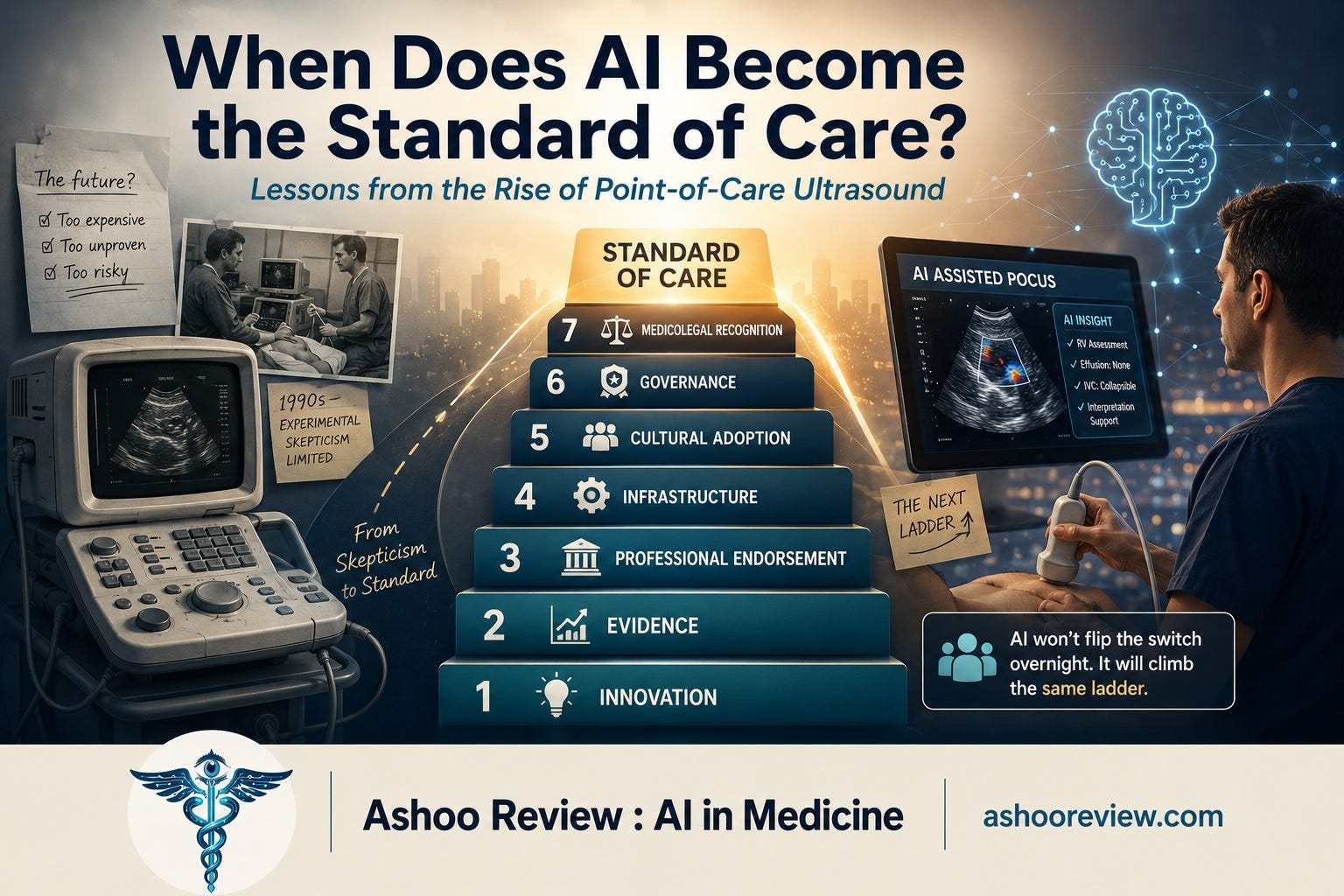
To see how a technology becomes standard of care, it helps to look at one that has already made the full journey. Point-of-care ultrasound (POCUS) offers an unusually clean roadmap, divided into seven identifiable steps.
1. Innovation. The technology itself predates its American emergency medicine adoption by decades. Clinicians in Europe and Japan used bedside ultrasound for trauma assessment as early as the 1970s. In the United States, the late 1980s and early 1990s produced a small group of early adopters, emergency physicians willing to look at a blurry image and ask whether it changed their clinical decision-making. Equipment was limited, skepticism was widespread, and the idea that a bedside scan could substitute for a formal radiology study struck many as reckless.
2. Evidence. Clinical studies accumulated over years. Grace Rozycki’s 1993 study of 476 trauma patients demonstrated that surgeons and emergency physicians could reliably detect free fluid at the bedside. The exam itself did not get its name, Focused Assessment with Sonography for Trauma, until an international consensus conference in December 1997, with results published in 1999. Evidence built specialty by specialty and application by application: trauma first, then pregnancy, cardiac, and procedural guidance.
3. Professional Endorsement. Institutional recognition followed the evidence, but slowly. ACEP issued a position statement backing physician-performed emergency ultrasound in 1990, then approved a dedicated Emergency Ultrasound Section in 1995. The real inflection point came in June 2001, when ACEP’s Board approved the first comprehensive Emergency Ultrasound Guidelines, the first time a major American specialty society formally endorsed bedside ultrasound as a core skill with defined training expectations. The guidelines were revised in 2008, retitled and expanded in 2016 to “Ultrasound Guidelines: Emergency, Point-of-Care, and Clinical Ultrasound Guidelines in Medicine,” and revised again in 2023.
4. Infrastructure. Machines became smaller and cheaper. Hospitals purchased equipment, and image archiving, billing codes, quality assurance programs, and workflow integration all had to be built around it. None of this happened automatically; it required systems engineering, IT integration, and financial justification, mostly after the guidelines existed to justify the spend.
5. Cultural Adoption. Residents began expecting to learn POCUS. Patients began expecting it. Hospitals started advertising bedside ultrasound capability. The technology moved from curiosity to baseline expectation.
6. Governance. Credentialing pathways emerged. Residency programs built ultrasound into formal curricula. Quality assurance programs began tracking image quality and interpretation accuracy over time.
7. Medicolegal Recognition. Here is where the standard of care quietly shifts. A 2022 review by Russ and colleagues in the Journal of Emergency Medicine examined POCUS malpractice cases filed between December 2012 and January 2021 and found that the dominant allegation was failure to perform, not misinterpretation. Jonathan Mezrich made the same point in Academic Radiology in 2025: physicians are now more likely to face litigation for not performing POCUS than for misreading it, calling it “a rare example where defensive medicine and patient care demands converge.” No single court case or guideline declared POCUS the standard. Evidence, endorsement, infrastructure, culture, and litigation converged until the question flipped from why would you do this to why didn’t you.
Where Is AI Today?
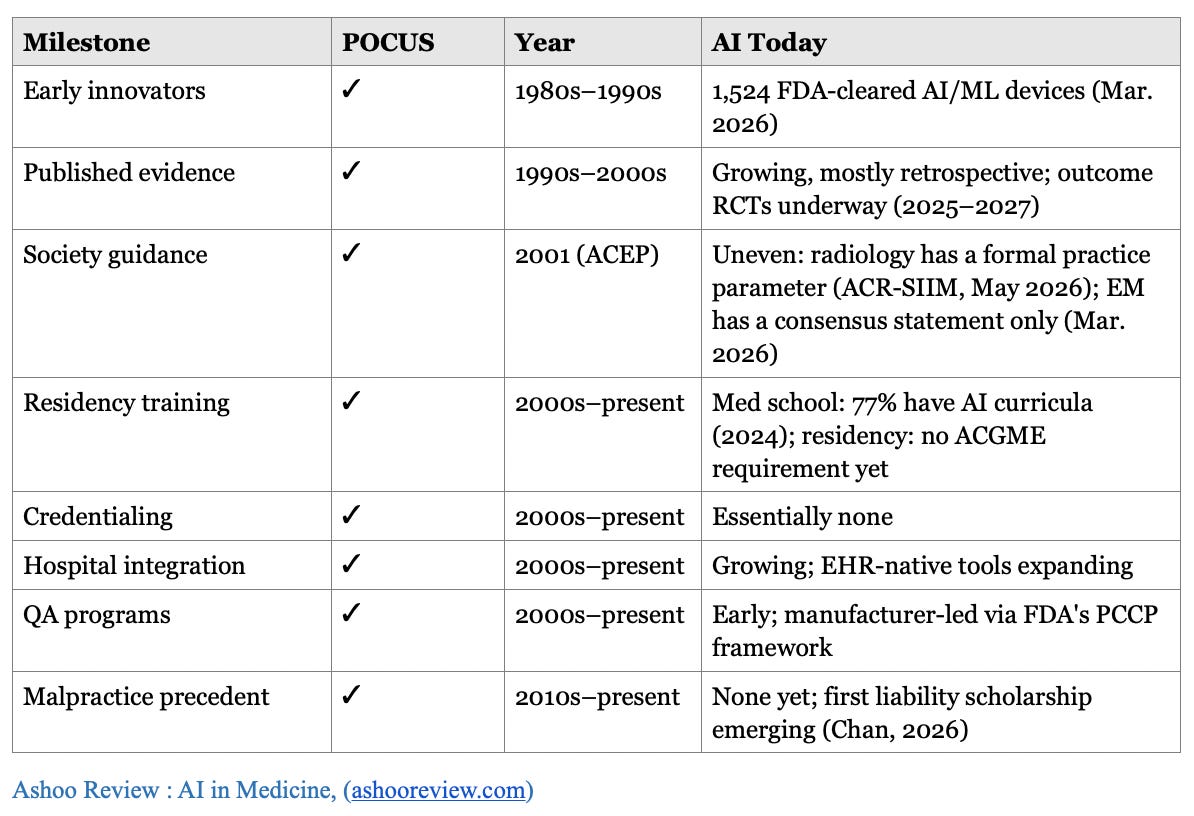
Let’s run the same seven steps against AI in medicine as it stands in mid-2026.
1. Innovation. AI has cleared this step. The FDA’s running list of AI- and Machine Learning-enabled medical devices passed 1,524 entries by the end of March 2026, with radiology accounting for 1,163 of them, about 76 percent. Cardiology alone now has more than 200 cleared algorithms. In 2025, the FDA cleared 295 new AI devices from 221 different manufacturers.
2. Evidence. This is a bit uneven. Retrospective validation is abundant: chest X-ray triage tools such as Qure.ai’s qXR line now carry 26 FDA-cleared indications across X-ray and CT, from lung nodule detection to intracranial hemorrhage triage, and prospective studies have shown measurable reductions in time-to-read for critical findings. ECG interpretation has a similarly mature evidence base. But outcome-level prospective evidence, the kind showing a mortality or morbidity benefit rather than a diagnostic-accuracy benefit, is still catching up. One of the more ambitious efforts, a cluster-randomized trial evaluating whether an AI chest X-ray triage system reduces mortality, isn’t expected to report full data until December 2027. For most other applications, especially complex diagnostic reasoning, the trials that would satisfy this step are still being designed.
3. Professional Endorsement. This step is moving at different speeds by specialty. In October 2025, ACEP hosted the first All Emergency Medicine AI Summit, convening SAEM, CORD, ACOEP, ABEM, AAEM, EMRA, AACEM, and AOBEM. The resulting consensus statement, published in March 2026, affirms that emergency physicians retain authority for patient care decisions and that AI should enhance rather than replace clinical judgment. That’s real, but it reads more like ACEP’s 1990 position statement than its 2001 guidelines: principles without defined training or credentialing standards. Radiology has moved further. In May 2026, the ACR Council approved the ACR-SIIM Practice Parameter for Imaging Artificial Intelligence, the specialty’s first formal practice parameter for AI and the same category of document as ACR’s Appropriateness Criteria. It sets expectations for governance, clinical validation, bias mitigation, and ongoing performance monitoring, and it’s paired with Assess-AI, a new quality registry that tracks real-world model performance against radiology-report-derived outcomes. That is, right now, the closest thing in medicine to a 2001-style guideline for AI.
4. Infrastructure. This is moving fast. Major EHR vendors have built native AI integration points, hospital AI governance committees are now common rather than novel, and the FDA’s Predetermined Change Control Plan (PCCP) framework, finalized in 2024, lets manufacturers update models without seeking a new clearance for every version. That matters more than it sounds: it’s a regulatory acknowledgment that AI infrastructure will need to absorb continuous change in a way POCUS equipment never did.
5. Cultural Adoption. The share of U.S. and Canadian medical schools incorporating AI into their curricula jumped from 53 percent in 2023 to 77 percent in 2024, according to the AAMC and AACOM’s Curriculum SCOPE Survey. Residency training lags behind medical school. ACGME hasn’t made AI competency a formal program requirement yet, though it’s gathering stakeholder feedback toward that end and added AI-focused sessions to its 2026 programming, and the AAMC’s own national AI competency framework for the full training continuum isn’t due until fall 2026. Patients are beginning to ask about AI-assisted diagnosis, and health systems increasingly market their AI capabilities. What’s still missing is the residency-level equivalent of a POCUS rotation: standardized, required, and tested.
6. Governance. This remains the messy middle. The FDA’s January 2026 revision to its clinical decision support guidance leans on what industry has started calling a “glass box” standard: CDS software must disclose, in plain language, its underlying logic, validation methodology, and the limitations of its training data, specifically to guard against automation bias. What’s still mostly missing is the hospital-side counterpart: credentialing pathways, and version-tracking systems that treat a model update the way a hospital treats a new piece of equipment.
7. Medicolegal Recognition. No case law yet establishes AI non-use as a deviation from standard care. But the fact that a Harvard Business School economist has now formally modeled the question tells you something about where the conversation has moved. More on that paper below.
What Still Has to Happen?
Some of the remaining milestones are already in motion, or already achieved in a single specialty, like radiology’s new practice parameter and the chest X-ray mortality trial cited above. Most are not, and none has happened across specialties broadly. The list that would move AI further up the ladder:
Clinical outcome studies showing mortality or morbidity benefit, not just diagnostic accuracy
Prospective trials rather than retrospective validation, across more than imaging and ECG
Professional society recommendations with the weight of the 2001 ACEP guidelines, in specialties beyond radiology, which already has one
Residency curricula that train every new physician on AI tools as a baseline skill
Board examination content that tests AI competency
Credentialing pathways for physicians using AI clinically
Hospital policies that define when and how AI is used
Workflow integration inside EHRs that makes AI a seamless part of clinical decision-making rather than an add-on
Quality assurance programs, run by hospitals rather than manufacturers, that monitor model performance over time
Version-control transparency that lets clinicians know when a model changed and how that changed its outputs
Independent benchmarking of commercial models against real, local patient populations
Malpractice case law that establishes precedent for when declining to use AI becomes indefensible
Why AI May Be Different
History doesn’t always repeat itself. There are real differences between POCUS and AI that complicate the transition:
Velocity of change. Ultrasound machines improved incrementally. AI models can change materially every few months, and the FDA’s own PCCP framework formalizes this: manufacturers can now pre-clear a range of future model updates in a single submission, meaning a device that behaves one way in 2026 may legitimately behave differently in 2027 without ever returning for a new review. Ultrasound machines never needed that provision.
Evolving outputs. A 2024 model doesn’t necessarily behave like a 2025 model. POCUS images don’t change their meaning retroactively; AI outputs can.
Probabilistic nature. AI recommendations are not visual. A radiologist can look at an ultrasound image and see what the physician saw. An AI recommendation is often invisible unless documented, complicating both quality assurance and medicolegal review.
Vendor fragmentation. Unlike ultrasound, dominated by a handful of manufacturers, the AI landscape is crowded with substantially different models, making standardization and benchmarking harder.
Continuous governance. With POCUS, governance was largely a one-time investment in training and equipment. With AI, governance is continuous: models drift, data distributions shift, and monitoring has to be perpetual.
Deskilling risk. POCUS extended the physical exam; it didn’t replace clinical reasoning. AI carries a genuine risk of cognitive atrophy, where physicians grow less capable of independent verification because they’ve grown dependent on the tool. POCUS has no direct equivalent of this risk.
These distinctions make the transition more complicated than the POCUS roadmap would suggest.
The Medicolegal Inflection Point
Here I want to sit with questions rather than answers.
If AI reliably detects subtle diagnoses that physicians routinely miss...
If AI consistently reduces missed findings across multiple validated studies...
If most emergency physicians in a community routinely use it...
If hospitals provide it as part of standard equipment...
If specialty societies recommend it in formal guidelines...
At what point does declining to use AI become difficult to defend?
A 2026 Harvard Business School working paper by economist Alex Chan, also circulated through the National Bureau of Economic Research, models exactly this transition: the point at which AI moves from a passive clinical tool to something that shapes what a reasonably prudent physician would do. Chan’s core question isn’t whether liability law should protect physicians who rely on AI. It’s whether the law should adapt its standards to AI’s specific failure modes, data drift, vendor-side updates, probabilistic rather than binary outputs, or force AI to fit liability frameworks built for static tools like a stethoscope or an ultrasound probe.
I don’t think this moment has arrived. But it may be closer than it feels, because the standard of care doesn’t announce itself with a press release. It shifts in the accumulated weight of evidence, endorsement, and litigation until the defense of “I didn’t use it” begins to sound hollow.
The Ladder as a Diagnostic Tool
The seven steps above aren’t specific to ultrasound. The same ladder applies to CT, MRI, and troponin testing, all of which climbed it long before POCUS did, and it applies just as well going forward, to next-generation sequencing or whatever comes after AI.
The value of naming the steps isn’t prediction. It’s diagnosis: for any technology you’re evaluating, you can ask which step it has actually reached, rather than which step its marketing implies it has reached. That’s precisely where most of the confusion about AI’s clinical readiness comes from, conflating step one (an FDA clearance exists) with step three (a specialty society has endorsed it) or step seven (declining to use it is indefensible).
Conclusion
Nobody predicted the exact year bedside ultrasound became routine. There was no ribbon-cutting ceremony. Looking backward, the progression seems obvious and inevitable. Looking forward at the time, it was uncertain and contested.
AI may follow a similar path. Or it may follow an entirely new one. The important question isn’t whether AI will become the standard of care. Given enough evidence, infrastructure, and cultural absorption, most useful technologies eventually do.
The important question is: How will I recognize the moment when it does?
Sources
Rozycki GS, Ochsner MG, Jaffin JH, Champion HR. “Prospective Evaluation of Surgeons’ Use of Ultrasound in the Evaluation of Trauma Patients.” Journal of Trauma. 1993;34(4):516–527. (476-patient study establishing the technique; predates the FAST name.)
Scalea TM, et al. “Focused Assessment with Sonography for Trauma (FAST): Results From an International Consensus Conference.” Journal of Trauma. 1999;46(3):466–472. (Consensus conference, Dec. 1997, that coined the FAST acronym.) PubMed
Rozycki GS. “Surgeon-Performed Ultrasound: Its Use in Clinical Practice.” Annals of Surgery. 1998;228(1):16–28.
Russ B, Arthur J, Lewis Z, Snead G. “A Review of Lawsuits Related to Point-of-Care Emergency Ultrasound Applications.” Journal of Emergency Medicine. 2022;63(5):661–672.
Mezrich JL. “POCUS in the Emergency Department: An Example of Convergence of Defensive Medicine With Patient Care.” Academic Radiology. 2025;32(Suppl 1):S126–S130. PubMed
ACEP. “Ultrasound Guidelines: Emergency, Point-of-Care, and Clinical Ultrasound Guidelines in Medicine.” Approved as “Emergency Ultrasound Guidelines,” June 2001; revised Oct. 2008; retitled and expanded June 2016; revised again April 2023.
Chan A. “Optimal Medical Liability for AI.” Harvard Business School Working Paper No. 26-087, June 2026; also NBER Working Paper No. w35321. NBER
FDA. “Artificial Intelligence-Enabled Medical Devices” database, last updated March 4, 2026 (1,524 total devices; 1,163 in radiology, ~76%; 295 new clearances in 2025 from 221 manufacturers).
FDA. “Predetermined Change Control Plans for Machine Learning-Enabled Medical Devices: Guiding Principles.” Final guidance, 2024.
FDA. Revised Clinical Decision Support Software guidance, issued January 6, 2026 (“glass box” transparency requirements, automation-bias framing).
ACEP, SAEM, CORD, ACOEP, ABEM, AAEM, EMRA, AACEM, and AOBEM. Consensus Statement following the first All Emergency Medicine AI Summit (Irving, TX, Oct. 2025); statement published March 18, 2026.
American College of Radiology, Data Science Institute. AI use-case repository and FDA-cleared algorithm tracker.