

In the past 18 months, the American Nurses Association, the American Academy of Nursing, and the American Medical Association have each published AI governance frameworks. They agree on the core principle: AI must support clinical judgment, not replace it. Human oversight is essential. Clinicians should be involved in procurement decisions. The frameworks differ in emphasis and scope, but they share the same foundational commitment and the same non-existent enforcement mechanism.
Meanwhile, nurses in New York, California, Michigan, and North Carolina have been striking and writing AI oversight rights into union contracts. The national nursing union organization that represents those same nurses is publishing its own AI bill of rights.
Both responses exist because the frameworks and the union contracts are answering different questions. Understanding why requires looking at which AI tools are actually being deployed, to whom, and at whose direction.
As always, if you enjoy reading, subscribe and tell a friend.
Sam
What the Professional Associations Agree On
The American Medical Association published formal AI principles in November 2023, adopted a transparency policy calling for independent third-party verification of AI explainability in June 2025, and released an 8-step governance toolkit in August 2025. The toolkit calls for multidisciplinary governance committees that include nursing leadership, staged deployment with pilot testing, and continuous performance monitoring after launch.
The American Nurses Association convened its inaugural AI in Nursing Practice Think Tank on April 22, 2026. The consensus findings identify automation bias and erosion of professional judgment as the primary risks, call for mandatory AI literacy as a core nursing competency, and push for nurse-led AI governance at the institutional level.
The American Academy of Nursing approved a comprehensive AI position statement on February 25, 2026, setting out 13 specific policy recommendations covering data privacy, algorithmic bias, FDA oversight, and human-in-the-loop oversight standards across all institutional governance policies.
The foundational language across all three documents is nearly identical: AI must augment clinical judgment, not replace it. The human clinician remains the final accountable decision-maker. Human-in-the-loop oversight is non-negotiable.
All three frameworks rely on the same implementation mechanism: voluntary institutional governance, multidisciplinary committees, professional education, and policy advocacy. None specifies what “human in the loop” requires at the point of care. None has an enforcement mechanism at the bedside level.
Two Categories of AI Tools
The governance frameworks were designed for a particular relationship between clinician and AI: the clinician chooses to use a tool, reviews its output, and retains authority over the final decision. The ambient scribe is the clearest example. The physician activates it, the scribe drafts a note, the physician reviews and signs. The tool serves the physician. Clinical judgment stays with the clinician throughout.
Physician AI adoption fits this model closely. By 2026, more than 80% of physicians report using AI in their professional work, with more than three-quarters saying it improves their ability to care for patients. The tools driving that adoption are documentation-focused: 70% of physicians at UCSF now use AI scribes daily, and Kaiser Permanente logged more than 2.5 million AI-scribed encounters over 14 months. Randomized trial evidence confirms that these tools reduce documentation time and burnout scores.
The AI tools most commonly deployed in nursing workflows belong to a different category. Patient acuity scoring algorithms analyze EHR data to determine how sick a patient is and predict how many nursing hours that patient requires. Staffing algorithms use those acuity scores to determine how many nurses are called into a shift. Automated handoff tools generate shift reports. Clinical deterioration algorithms produce alerts. These tools are not activated by the nurse. They are deployed by hospital administration, they run continuously, and their outputs directly constrain what nurses do and how many patients they are assigned.
The NNU’s 2024 survey of 2,300 members documented what this looks like in practice. Half of respondents said their employer uses algorithmic systems to determine patient acuity and predict required nursing hours. Of those, 69% said the AI-generated acuity score did not match their own clinical assessment. Among nurses whose employers use automated handoff tools, 48% said those AI-generated reports contradicted their own patient assessment.
The Override Problem
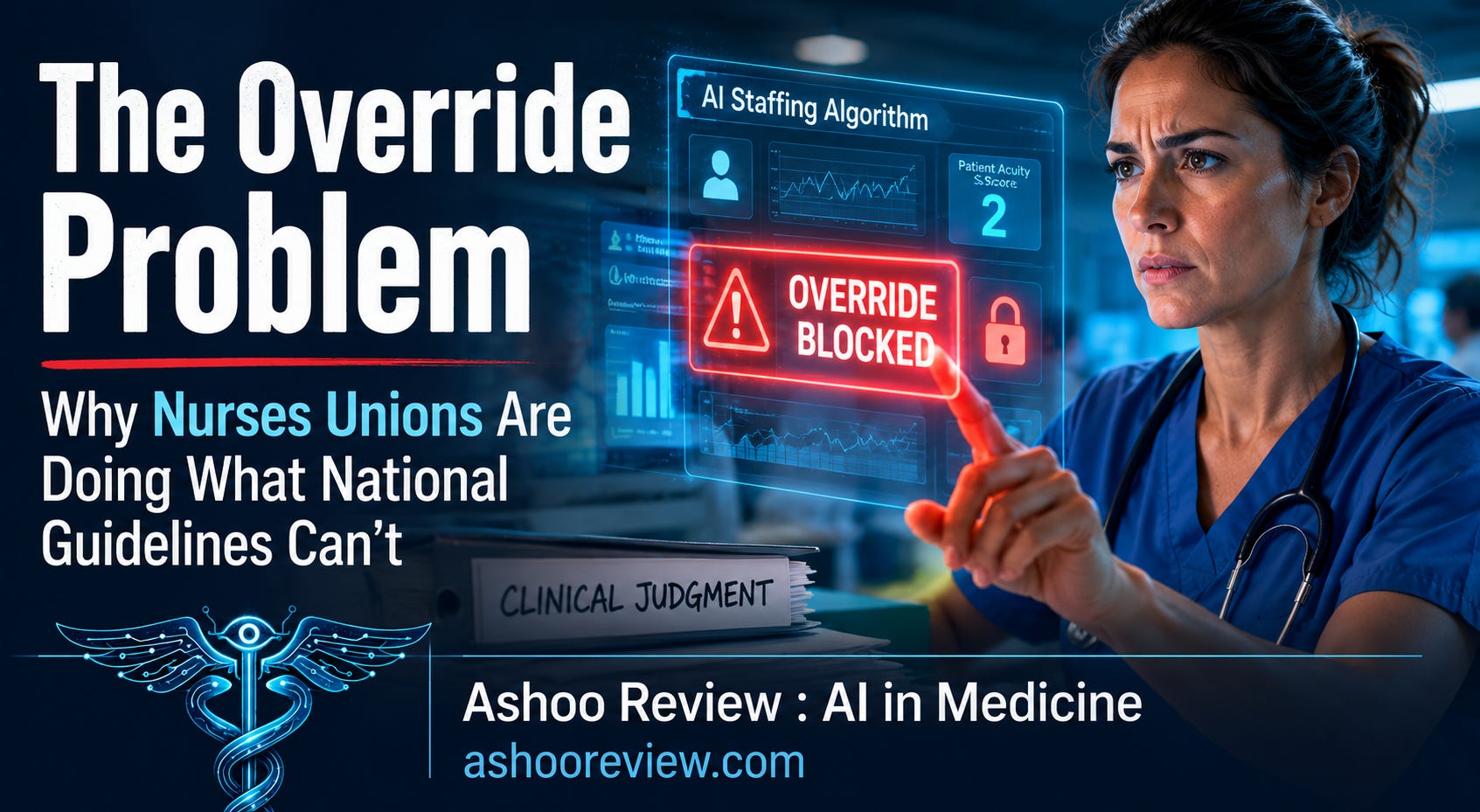
Forty percent of nurses in hospitals using algorithmic patient outcome tools said they cannot override the algorithm’s prediction when their clinical assessment differs. Twenty-nine percent said they cannot alter algorithm-produced wound or pain documentation in the EHR even when they believe it is inaccurate.
Every professional association framework, including the ANA, AAN, and AMA documents described above, establishes that clinical judgment must prevail over AI outputs. The survey data documents a significant gap between that principle and what is happening at the bedside, and the governance frameworks have no mechanism to close it.
The gap has a structural explanation. The patient acuity and staffing tools that nurses cannot override were not purchased by clinical leadership. They were sold to hospital CFOs and operations teams on the explicit promise of reducing labor costs. Vendor marketing for these systems is direct: AI staffing tools minimize overtime, reduce reliance on expensive agency nurses, and cut contract-labor dependency. Ascension Health reported reducing contract-labor dependency by 15%within six months of implementing a predictive staffing system.
A nurse who can override her acuity score is a nurse who can force additional staffing. Override capability undermines the tool’s core value to its actual customer. The inability to override is not a design flaw. It is, from the purchaser’s perspective, a feature.
Many of these operational tools, including staffing algorithms and acuity scoring systems, also do not meet the FDA’s current definition of a medical device. They face no premarket safety review requirement. No regulator required the vendor to build in an override function, and no regulator currently enforces one.
Presence Without Agency
The academic literature has recently begun to examine what “human in the loop” actually means in practice. A paper in the American Journal of Bioethics specifically flags that researchers and institutions routinely invoke HITL as ethical legitimacy without specifying which humans, in which processes, are doing what, and cites NNU survey data on nurses unable to override algorithmic predictions as a concrete example.
The Institute for Systems Integrity published a related framework in May 2026, distinguishing between two states that are often conflated. In the first, a human is present near the AI system: they are notified, they see the output, and they are in the loop in the awareness sense. In the second, a human has agency: they can interrupt the system, modify its output, or substitute their own judgment without penalty. The institute’s framing is clear:
“A human placed near an AI system is not automatically a safeguard. A clinician asked to approve a recommendation under time pressure, incomplete information, workload overload, and unclear authority may not be exercising judgment.”
The EU AI Act makes this distinction legally operational for high-risk AI systems. Article 14 requires that humans be able to interrupt or override the system’s operation and decide not to use it in a specific situation. This is described as an architectural requirement, not a procedural right. No equivalent US requirement exists for hospital operational AI tools.
A nurse who receives an acuity score that cannot be changed has been notified. That nurse has not been given authority.
What The NNU Is Doing
The National Nurses United published a Nurses and Patients’ Bill of Rights in April 2024. Seven rights are enumerated. Most coverage of this document focuses on Right 7, which demands pre-deployment bargaining rights: the right to negotiate over whether and how AI is implemented before the system is selected.
Right 5 is less examined and more operationally significant given the override data. It establishes the right of nurses to exercise professional judgment and override AI decisions without threat of discipline or discharge. No professional association framework, from the ANA, AAN, or AMA, contains an equivalent enforceable protection. Right 5 is the only document in the current governance landscape that directly addresses what 40% of nurses report experiencing.
The NNU has coordinated a national bargaining campaign through its affiliate network: the California Nurses Association, the New York State Nurses Association, the Michigan Nurses Association, and the National Nurses Organizing Committee in North Carolina. Announced AI contract language has been reported at Mission Hospital in Asheville, North Carolina (2024), Northwell South Shore University Hospital in New York, the New York City hospital systems including NYP, Montefiore, and Mount Sinai following a strike by nearly 15,000 nurses in February 2026, Munson Medical Center in Traverse City, Michigan, and the University of California system, where a contract ratified in November 2025 specifies that nurses play a central role in selecting, designing, and validating new technology including AI systems.
One caveat applies to all of the above. No journalist or outlet has quoted actual contract clause text from any of these agreements. Coverage consistently describes outcomes in terms of “safeguards,” “guardrails,” “approval before deployment,” and “voice in how AI is rolled out.” Whether the ratified language reflects the specificity of the Bill of Rights, including Right 5’s override protection, or represents a narrower pre-deployment consultation right, is unknown without the contract documents.
The physician union equivalent, the Union of American Physicians and Dentists, has identified AI as a bargaining priority, with the organization’s president stating in December 2025 that it is “imperative” that the union engage in dialogue with employers to prevent professional judgment substitution by AI. UAPD has not yet produced ratified AI contract language. That gap is approximately 18 months, which is consistent with the tool asymmetry: physicians have not yet encountered operational AI deployed on them at scale without override rights.
Two Tracks, One Unresolved Problem
The landscape across both professions is now parallel. Both nursing and medicine have a professional association track and a union track responding to AI.
The ANA and AAN are doing what the AMA is doing: publishing principles, developing governance frameworks, and advocating for policy. The difference in urgency between the nursing professional associations and their physician counterparts reflects the difference in tool adoption rates and trust levels, not a fundamental strategic divergence.
NNU is doing something the professional associations can’t do: creating enforceable bedside protections through contract law. They are addressing different layers of the same problem. A hospital can have an excellent AI governance committee and still deploy an acuity algorithm with no override function. A union contract can protect override rights but cannot prevent a poorly validated tool from being purchased in the first place. Both layers are needed.
Neither layer has resolved the problem of definition at the center of all of this. Every framework, every position statement, every contract announcement invokes human oversight as a governing principle. No one has established that human oversight requires the ability to override. Until that definition is settled, “human in the loop” describes a spectrum that runs from a nurse with full authority to substitute her/his clinical judgment to a nurse who receives a notification she/he cannot act on. Both nurses are, technically, in the loop.
Questions Worth Asking
If you are responsible for AI governance at a hospital or health system, the relevant question is whether your governance committee’s approval process specifies override capability as an architectural requirement of deployment instead of a recommendation. A tool that generates outputs clinicians cannot modify does not meet the HITL standard described by the ANA, AAN, or AMA, regardless of what the vendor’s documentation says.
If you are a nurse in a facility with a union contract that includes AI language, the clause text matters more than the press release. “Safeguards” and “guardrails” are not contract language. Right 5 of the NNU Bill of Rights, protection of the right to override without threat of discipline, is the protection most directly supported by the survey data. Whether it appears in your contract is a question worth answering.
If you are a nurse in a non-unionized facility, the ANA Think Tank consensus document and the AAN position statement establish a national professional standard you can cite through shared governance structures or unit councils when raising concerns about tools that cannot be overridden.
If you are a physician, the operational AI category that nursing is responding to is not exclusive to nursing. The tools that constrain clinical judgment without requiring clinical input in procurement are already present in prior authorization, clinical documentation, and diagnostic triage. The UAPD’s December 2025 statement suggests that physician union organizing around AI is overdue.
The governance frameworks say clinical judgment must prevail. The mechanism that makes that principle enforceable at 3am, when an acuity score determines whether a second nurse comes to the floor, does not yet exist in voluntary guidelines.