

Last week, the Pew Research Center released the results of a survey of 3,488 U.S. adult patients on their perspective on AI in Healthcare. The findings were informative, but they are even more interesting if you combine them with what we know from similar surveys of physicians. Let’s dive into that comparison.
As always, if you enjoy reading, subscribe and tell a friend.
Sam
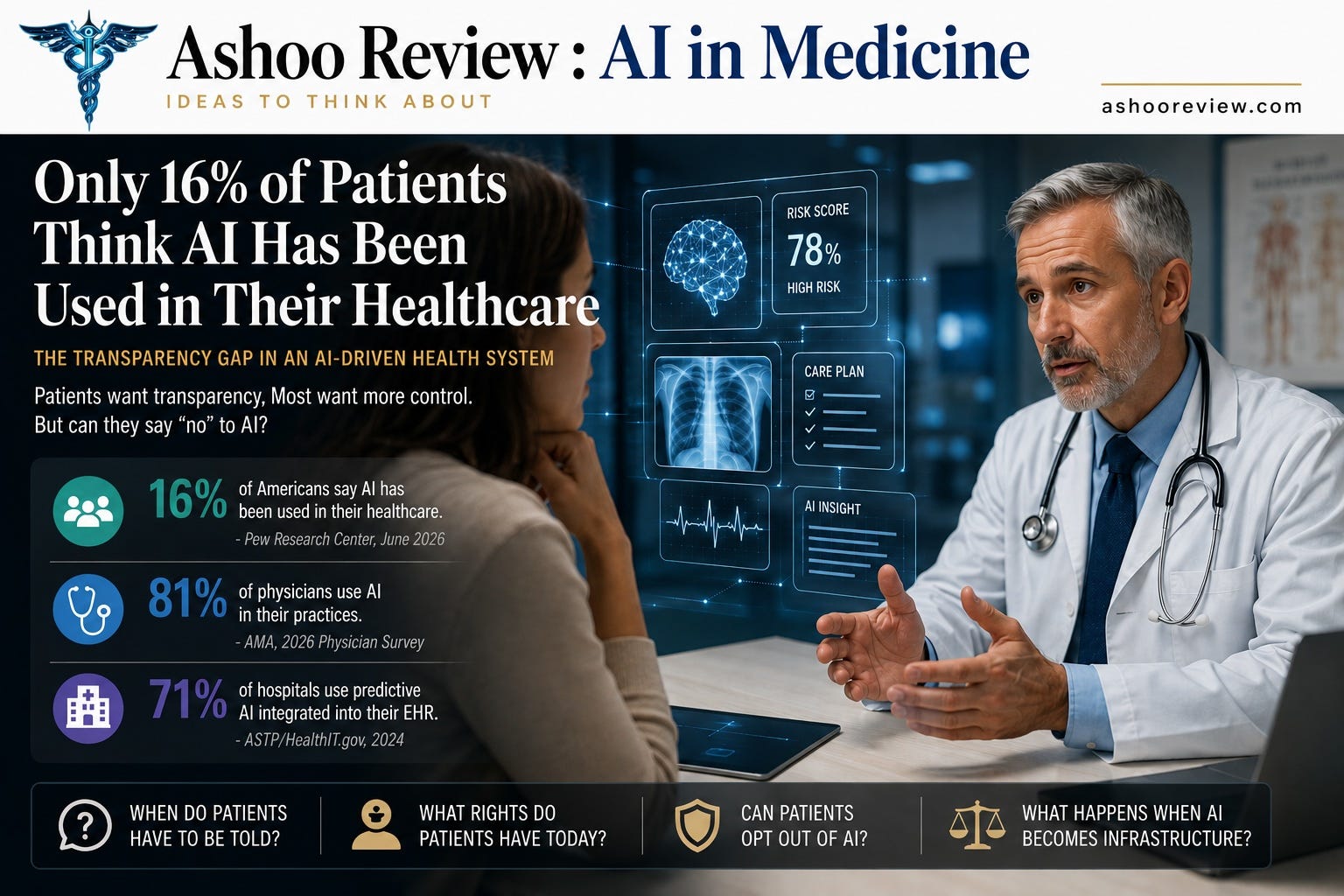
The Awareness Gap
The Pew Research Center surveyed 3,488 U.S. adult patients from June 22 to 28, 2026, on their perspective on AI in Healthcare. The findings highlight a big difference between patient and physician views on AI use in Healthcare. The Pew Research Center’s results found:
A small share (16%) say their doctors or other healthcare providers have ever used AI in their healthcare.
Additionally, another 83% of Americans either think AI has never been used in their healthcare (37%) or don’t know if it has (46%).
Compare that to the AMA’s 2026 Physician Survey on Augmented Intelligence, which reported:
Four in five physicians (81%) use AI in their practices, more than double the 2023 rate (38%).
That leaves a significant gap that we, physicians and clinicians, need to explain. One explanation might be the way that the AMA defined AI use. The survey listed 17 AI use cases. 72% of physicians said they incorporated at least one of them. 9% said they were not sure which ones their practices used. The survey results combined these two groups.
A second explanation might be the tools themselves. Physicians said they used AI for research summarization, documentation, discharge instructions, care plans, and billing. So an individual physician could be using AI according to the AMA, but not in a manner that a patient would be aware of or consider personal to them.
But that’s just at the physician level. Federal data shows that AI use in healthcare goes beyond what individual physicians choose. According to the ONC:
In 2024, 71% of hospitals reported using predictive AI integrated into their EHR.
Think of hospital systems that predict readmissions, identify high-risk patients or early sepsis, and generate treatment recommendations.
But if all three surveys measured something different, can they be used to find a correlation between physician AI use and patient awareness? Not directly, but the gap between 16%, 81%, and 71% is certainly a signal. AI use in healthcare is significant among physicians and hospitals, while very few patients know it is being used.
That raises another question: How would a patient know?
Defining AI Use in Healthcare
Before we figure out how a patient would find out about AI use, we have to define it. Consider these five scenarios:
AI Q&A: A physician asks an AI search tool a quick question about current treatment recommendations and then uses that answer to treat a patient. No patient information is shared.
Clinical Decision Support: A physician enters a patient’s history, labs, and imaging results into an AI system and asks for a differential diagnosis and treatment plan.
Ambient Scribe: A physician uses an ambient scribe to document a patient encounter.
Prediction: An AI prediction tool flags a patient as having a high probability of deterioration and a high risk of readmission after discharge.
Prioritization: An AI model prioritizes radiology studies for radiologists to read, schedules appointments, generates billing codes, and helps with insurance claims.
All 5 scenarios would be considered AI use in healthcare, but their relevance to a single patient varies quite a bit. When the Pew Research Center asked patients if they should be told about specific AI applications, they found:
81% want to know if AI was used to analyze their medical scans or make a diagnosis.
80% want to know if AI was used to explain their lab results.
72% want to know if AI was used to take notes during an appointment.
64% want to know if AI was used to refill a prescription.
56% want ot know if AI was used to schedule an appointment.
Though the first few did not surprise me, the last one did. Patients use a much broader boundary for being informed about AI, even for administrative tasks. This difference in definition creates another problem:
At what point does general AI use in healthcare become AI use in a patient’s healthcare?
When Do Patients Have to Be Told?
If we ask patients, the Pew Research Center found
About seven-in-ten U.S. adults (72%) say it’s extremely or very important that a doctor or other healthcare provider tells them if they’re using AI in their healthcare.
And yet, there is no national requirement that every use of AI connected with a patient’s healthcare be separately disclosed. Also, medicine has long used medical decision support tools without disclosing them to patients. That predates today’s generative AI tools. Think tools like ECG computerized interpretations, risk calculators, drug interaction alerts, clinical decision tools like Up-To-Date, and more. But if we have never disclosed these in the past, do we need to disclose them now just because they include AI processes?
What if those systems run autonomously, have access to patient information, generate new content (not just summaries) like patient-specific diagnoses or treatment plans, or contain errors that are difficult for humans to detect? Does that reach a threshold for patient notification?
In a JAMA article, Mello and colleagues proposed two factors for consideration:
The ethical obligation to notify patients depends on (1) the seriousness of the physical risk and (2) the extent to which patients have a meaningful opportunity to exercise agency in response to a notification.
This kind of approach creates different disclosure expectations for an AI system that influences a cancer diagnosis than one that schedules appointments. But Pew Research Center results suggest that patients may want disclosure in both cases. In fact, some states have already begun drafting laws to mandate it.
California AB 3030 requires disclosure for certain patient communications generated using AI. But the law also contains an important exception: “If a communication is generated by generative artificial intelligence and read and reviewed by a human licensed or certified health care provider, the requirements of subdivision (a) do not apply.” California Legislature
Texas has adopted broader language: “If an artificial intelligence system is used in relation to health care service or treatment, the provider of the service or treatment shall provide the disclosure.” Texas Business & Commerce Code
What we are beginning to see is a state-by-state patchwork in which disclosure obligations can depend on where care occurs, what the AI does, and how humans interact with its output.
For more state AI laws, see this previous article.

Being Told Is Different From Being Able to Say No
Another problem that may occur to you as you read this: Informing a patient of AI use improves their awareness. But what if they don’t consent? Is there an option to say no?
The question highlights the three aspects of this process:
Disclosure: Telling the patient that AI is being used.
Consent: Asking the patient for permission before using the AI software.
Control: Allowing the patient the ability to refuse that use.
The Pew Research Center’s survey shows that Americans are interested in all three, especially the last one.
Some might turn to HIPAA to provide guidance. After all, HIPAA already allows protected health information to be shared for treatment, payment, and healthcare operations under specific circumstances.
According to HHS:
The Privacy Rule permits, but does not require, a covered entity voluntarily to obtain patient consent for uses and disclosures of protected health information for treatment, payment, and health care operations.
Read it carefully. HIPAA permits but does not require consent. It is a voluntary process. In fact, that federal framework includes technology companies functioning as business associates. HHS specifically gives this example of an approved business associate.
Third-party vendor Artificial Intelligence (AI) chatbot on a provider’s patient portal that provides services involving the patient’s PHI such as symptom assessment, medical reminders, and appointment scheduling.
That means an AI vendor can access protected health information (PHI) with a HIPAA-compliant arrangement without the patient having to sign a separate authorization for AI use. But if we look at the Pew Research Center’s survey results, 63% of patients want more say over whether AI is used in their care. This becomes an issue because a healthcare organization can check all the disclosure boxes simply by informing a patient that it uses AI, with no way for the patient to opt out.
So HIPAA does not create a right to opt out of AI use in healthcare. But is it even possible anymore?
For an ambient scribe service, the physician just documents manually. It’s slower but still possible. What about a patient who asks that their information not be processed by:
an EHR deterioration model
AI-assisted radiology software
automated ECG interpretation
medication safety algorithms
radiology worklist prioritization
scheduling algorithms
billing systems
All of these are out of an individual physician’s control in the vast majority of practices. There is no mechanism to turn them off, or to process patient information without them. Many of them are operating in the background, automatically. As AI becomes increasingly embedded within healthcare infrastructure, a patient’s ability to opt out becomes impossible.
And what if opting out of AI use results in poor care for the patient? As AI systems improve, they will assist in everything from radiology interpretation to early detection of deterioration. Opting out might result in much longer interpretation times, fewer automated safety checks, and additional administrative delays.
If you work in a hospital, you might be asking yourself if the right to refuse AI requires a parallel workflow. Are hospitals obligated to maintain an alternative, and what would that even look like in a world where AI is embedded in the EHR?
AI Is Arriving Faster Than the Rules Around It
It’s a common theme across all the articles in this newsletter, and the Pew Research Center’s survey results are just another example. AI adoption is moving at a faster pace than the rules and laws around it.
Patients want transparency about AI use and more control over whether it participates in their healthcare. And we don’t have answers to:
What constitutes AI use in an individual patient’s care?
Which uses require disclosure?
When should disclosure include consent?
Which uses should patients be allowed to refuse?
How should healthcare systems accommodate refusal when AI has become part of their infrastructure?
With each passing day, these questions become harder to defer.
One thing we should certainly do is better define what is meant by the term AI. I believe the single most damaging thing the modern AI industry has done for technology generally is to lump LLMs in with the rest of what we have been calling AI for nearly 70 years.
Useful pre-LLM AI, e.g. computer aided diagnosis, has been around since the late 80s and image classifications specifically linked to medical research began in the 50s. We run a very real risk of a backslide in quality of care if we let someone other than the medical community determine where that choice lies without clearly defining the difference between the current AI trend and everything that came before it.