

A shift is occurring in the marketplace as AI scribe services integrate clinical decision support. The idea: context from the scribe is better than a physician’s manual prompt, and the opportunity may allow for fewer clicks … hopefully. Could this combination really improve our workflow? Let’s get into it.
As always, if you enjoy reading, please subscribe and tell a friend.
Sam
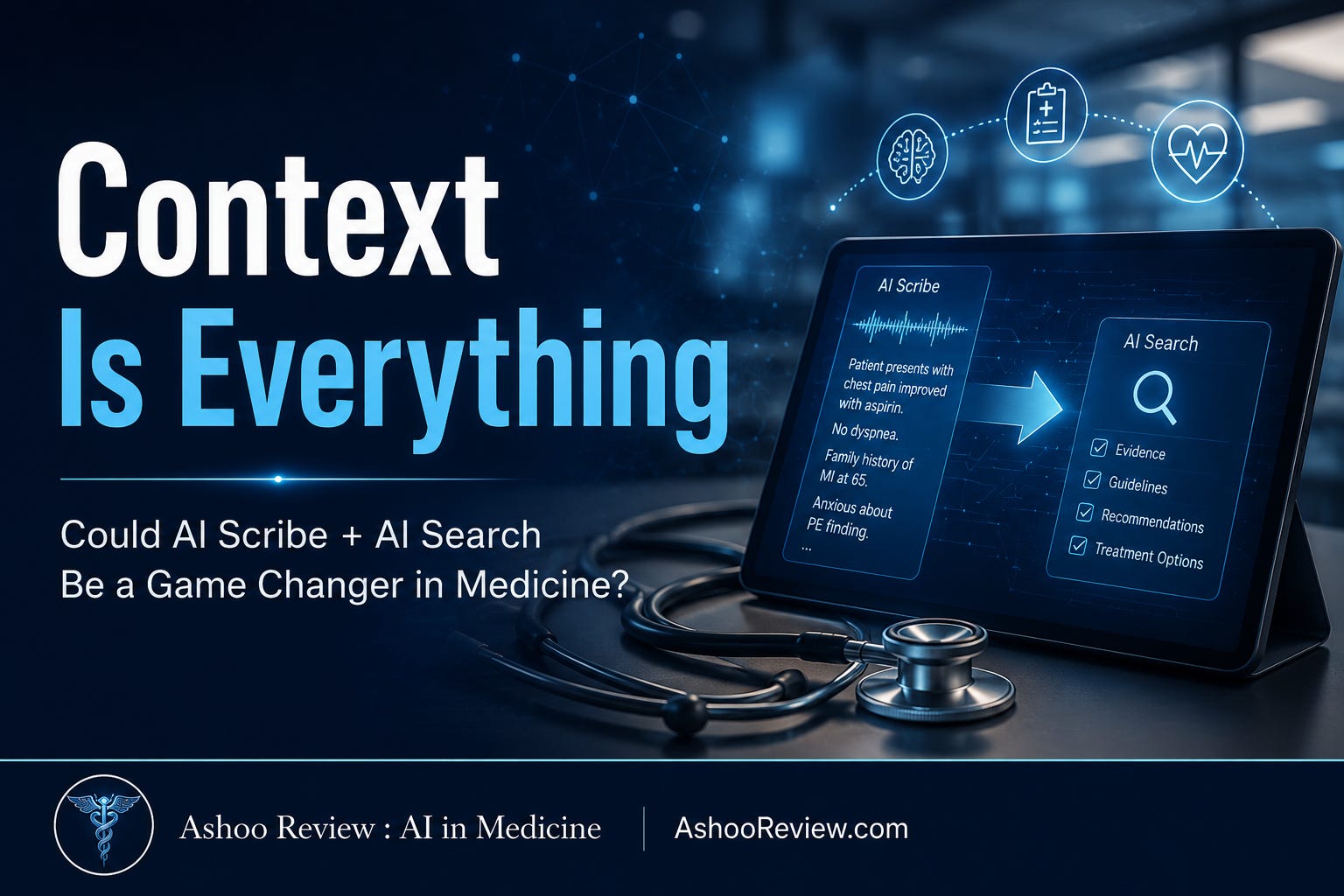
When a clinician has a question during an encounter, the workflow is straightforward. They recognize the need for evidence. They leave the patient, open a search tool like OpenEvidence, UpToDate, AMBOSS, or Doximity, formulate a query, and try to find an answer. Then they return to the chart and translate that finding into a plan.
It takes time and requires cognitive effort. It also interrupts the clinical workflow.
What if that entire sequence could be automated by pairing two things that currently operate independently: a scribe that captures context and an AI search tool that needs context?
If it works the way vendors are beginning to market it, the implications could be substantial.
The Manual Search Problem
Clinical decision support tools are valuable. The problem is that clinicians rarely use them consistently.
Adoption of standalone clinical decision support (CDS) has hovered between 20 and 50% for more than a decade. When adoption rates exceed 50% in any health system, it’s usually because the tool was so deeply embedded in workflow that using it became invisible. Not a conscious decision to “search for evidence,” but a byproduct of how documentation already worked.
The Agency for Healthcare Research and Quality (AHRQ)‘s evidence on clinical decision support has long established this pattern. In a 2005 study on clinical information needs, Ely and colleagues found that the most common reason physicians did not pursue answers to clinical questions was time. Not having access to tools, or skepticism about the instrument. Every additional click, every additional screen, every additional cognitive step to formulate what you’re searching for, all of that is friction.
The manual prompt introduces friction at multiple points.
First, the clinician has to recognize that they need help. That alone is cognitively taxing when you’re in the middle of an encounter and managing multiple competing hypotheses simultaneously.
Second, they have to formulate what they’re searching for. They have to decide what context matters. For example, a 65-year-old woman with a subsegmental PE is the bare minimum. But the clinically relevant narrative includes much more: her main symptom was chest pain, her father died of an MI at 65, she has no dyspnea despite the imaging findings, she’s anxious about the PE diagnosis. The question is whether the clinician remembers or prioritizes all of that when they type a prompt. Often they don’t. They reduce it to what feels immediately salient.
Third, they have to type it. And then translate the results back into their documentation.
Each of these steps is a place where information can be lost. Each is a place where a busy clinician can decide it’s faster to just make a decision than to go through the process.
The result: CDS adoption stalls. Not because the tools don’t work, but because the friction cost exceeds the perceived benefit.
What If Context Was Automatic?
Now consider a different architecture.
A scribe is already listening to the encounter. It’s capturing everything: chief complaint, associated symptoms, what improved with aspirin, the patient’s expressed anxiety about the PE finding, the absence of dyspnea despite imaging, family history, the nuance of how the history actually unfolded. The scribe structures that into a clinical note.
What if that same structured encounter context became the automatic input to downstream AI search and clinical decision support?
The difference is subtle but consequential. Instead of waiting for the clinician to recognize they need help and formulate a prompt, the system works from what’s already been captured. The context is automatically available. The search doesn’t depend on the clinician deciding what matters or remembering to type it.
This is the architectural shift vendors are now building.
Glass Health combines ambient scribe with a clinical reasoning layer that accesses the encounter transcript. When the scribe finishes capturing the visit, the same data becomes context for CDS reasoning, not a separate step, not a separate prompt, but the natural downstream use of data already captured.
Microsoft’s DAX Copilot generates the note from the scribe, then uses that same encounter context to surface order suggestions within Epic. The clinician doesn’t have to prompt for order ideas; they arrive pre-staged, informed by what was actually discussed.
Abridge, after expanding into real-time prior authorization through an Availity partnership announced in January 2026, is pre-populating prior auth requests with encounter context. The clinician reviews, not writes.
Ambience Healthcare’s AutoScribe provides real-time coding suggestions, quality measure tracking, and automated prior authorization recommendations, all triggered by the scribe context, all without requiring the clinician to initiate a separate search.
In each case, the pattern is the same: scribe captures context automatically, downstream systems act on that context without waiting for the clinician to formulate a prompt.
Why This Matters
If CDS adoption has been stuck at 20-50% because clinicians won’t use tools that require extra steps, and if integrated scribe-plus-search systems eliminate that friction by making context automatic and routing recommendations directly into workflow, then adoption could shift.
Not because the search tools suddenly became better. But because the context became richer, the friction resolved, and the recommendations arrived where clinicians are already working.
There’s a secondary automation gain as well. Once encounter context is structured and available, systems downstream can act without additional clinician prompts. Abridge is already doing this with order placement. The prior authorization request comes pre-populated. The labs or imaging recommendations arrive as suggestions for review, not as questions requiring the clinician to type more information.
Each of these automations removes a decision point. Each removes a place where context can be lost, or a clinician can opt out because the friction became too high.
This is different than asking “are AI search tools more accurate when they have more information?” This is asking whether integrated scribe-plus-search systems could achieve the adoption curves and utilization patterns that standalone CDS have chased unsuccessfully for years.
Where This Is Already Shipping
The market is moving in this direction. The examples above are live products, deployed now.
OpenEvidence, Doximity, and Glass Health offer scribe plus clinical decision support in the same interface.
DAX Copilot’s order suggestions are live within Epic.
Abridge’s prior authorization workflow doesn’t require the clinician to re-enter what was already discussed with the patient; the scribe context carries it forward.
Athenahealth made its ambient scribe free to all customers in February 2026. The company has explicitly positioned the scribe as a foundation for downstream clinical and administrative workflows.
These aren’t experimental pilots. They’re market moves. Multiple vendors are racing to integrate scribe plus CDS, scribe plus order suggestions, scribe plus prior authorization, and scribe plus billing optimization. The race itself suggests vendors believe integration is where the value is concentrating.
The Evidence Question
AHRQ best practices emphasize that CDS embedded in clinical workflow achieves significantly higher adoption rates than standalone tools.
The Rotenstein et al. study published in JAMA in April 2026 tracked 8,581 clinicians across five academic medical centers and found that 79% of eligible clinicians declined to adopt a scribe when it was offered as a standalone documentation tool. Among those who did adopt, only 32% used it in 50% or more of visits, the threshold where benefits actually accumulated.
But at organizations where the scribe was deliberately integrated into clinical workflow with physician champions, hands-on training, and customization of documentation to match local practice, adoption reached 75-80%.
Central Oklahoma Family Medical Center saw minimal scribe adoption in year 1 when it was positioned as a documentation tool. In year 3, after deliberate workflow integration and physician-led training, the system was generating over 14,000 records annually.
Research supports the pattern: embedded tools are better than standalone tools. Integrated workflows are better than siloed workflows. Friction is the constraint, not technology limits.
However, there is no published comparative adoption study in the same health system measuring scribe-only utilization versus integrated scribe-plus-CDS utilization. The vendors are claiming that integration drives adoption. The friction research supports that claim logically. But direct comparative evidence is absent.
That gap is fixable. It’s also important. If the thesis holds that integrated scribe plus CDS achieves meaningfully higher adoption than scribe-only, that would directly support the “game changer” framing. Until that evidence exists, we’re working from logical inference and market positioning, not real-world data.
What Changes Clinically
Let me be concrete about what this looks like in practice.
Today’s workflow: A 65-year-old woman presents with chest pain, elevated troponin, and a subsegmental PE on imaging. The clinician needs to decide between acute coronary syndrome and a low-risk PE with incidental findings. They recognize they need evidence about ACS risk stratification and PE disposition pathways. They leave the encounter, open OpenEvidence or UpToDate, search for something like “subsegmental PE,” scan results, and return to the chart with an answer. Time cost: 5-10 minutes. Friction cost: context loss between encounter and search.
Tomorrow’s workflow: The same patient, same presentation. The scribe has captured the full encounter: the aspirin response, the specific way the history unfolded, the family history details, the absence of dyspnea. Once the note is drafted, that encounter context automatically feeds into CDS reasoning. Before the clinician even finishes reviewing the note, recommendations about ACS risk stratification appear inline. They’re specific to what was discussed, not to a reductive prompt. The clinician reviews and acts. No extra steps. No context loss.
The difference isn’t speed alone. It’s that the clinical reasoning is informed by what actually happened, not by what the clinician decided was relevant enough to type.
What Has to Be True for This to Work
This only works if several conditions hold.
Scribe accuracy matters more. If the scribe omits a symptom or invents a clinical detail, everything downstream breaks. Recommendations based on false or inaccurate context are worse than no recommendations. The accuracy bar for a scribe that feeds into automation is higher than for a scribe that just generates a note for a clinician to review and edit.
Context routing has to be intelligent. Not every piece of encounter context should trigger every possible recommendation. Signal-to-noise matters. If the system fires off ten recommendations per encounter, most of which are irrelevant, clinician trust collapses. Integration has to include filtering and prioritization logic that decides what context maps to what recommendations.
Integration has to be seamless. If embedding CDS into the scribe workflow adds steps, the friction returns and adoption stalls. The system has to route recommendations directly into existing documentation workflows without requiring the clinician to open new windows, review separate interfaces, or translate between formats.
Liability has to be clear. If a scribe misses a clinical detail, who’s responsible? If CDS gives a recommendation based on scribe context and it’s wrong, who bears the liability: the scribe vendor, the CDS vendor, the clinician, the health system? Until those questions are answered clearly, adoption will be cautious.
Clinicians have to adopt the pattern. The mental model of “don’t prompt, just accept recommendations” is new for many physicians. It requires trust in both the scribe's accuracy and the CDS's reasoning. It requires that clinicians believe recommendations are being triggered appropriately, not indiscriminately. Building that trust takes time.
Conclusion
The architectural logic is sound. Pairing a scribe that captures context with CDS that needs context could eliminate the friction that’s kept adoption low. Integration could shift clinical decision support from a tool clinicians invoke when they have time to a system that informs their thinking automatically.
But “could” and “does” are different things. The market believes in this direction. Vendors are shipping products built on this assumption.
The evidence, though, is still emerging. The comparative adoption study doesn’t exist yet. The real-world error profiles haven’t been published. The liability frameworks are still being negotiated.
What we’re watching is an inflection point. The question isn’t whether AI scribes plus AI search could be a game changer. The architecture is sound enough that it’s plausible. The question is whether the systems being deployed right now will deliver on that promise at scale.
That’s worth paying attention to.