

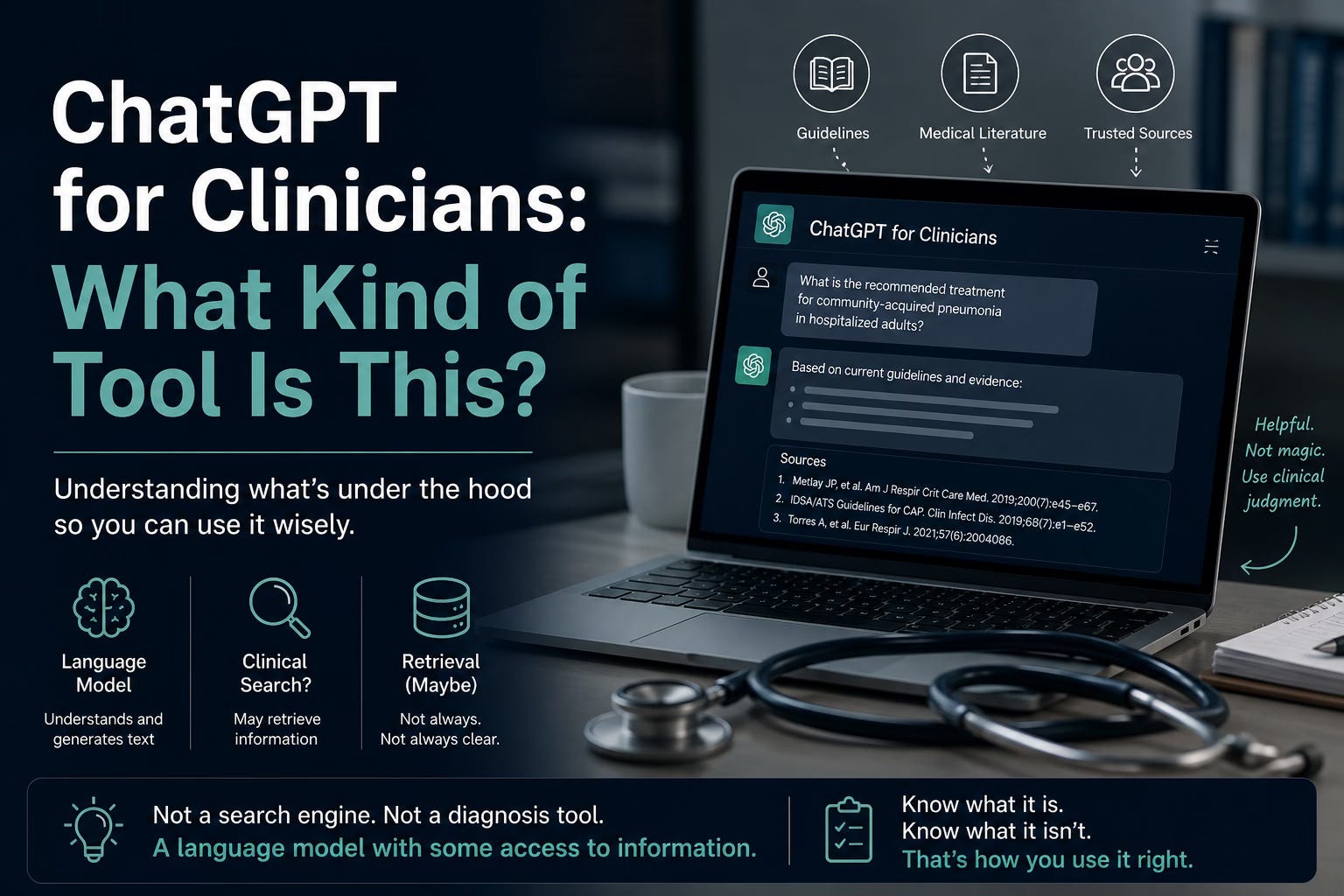
ChatGPT for Clinicians is being positioned as a tool for documentation, clinical questions, and literature review. It is essentially the individual clinician-facing version of OpenAI’s broader healthcare offerings, designed for use outside of enterprise health system deployments. The more important question is what kind of system it actually is. Is this a search tool? A reasoning assistant? Something in between? Before thinking about whether it works, it helps to understand what it is.
A language model, first
At its core, ChatGPT for Clinicians is still ChatGPT. It is built on a large language model that interprets clinical questions, synthesizes information, and generates responses. In practical terms, it retains most of the core capabilities of standard ChatGPT, but is scoped more narrowly for clinical use, with some features such as image generation intentionally excluded. It can summarize a chart, draft an assessment and plan, or walk through a differential.
It also carries the same limitations. It can sound confident and still be wrong. It can compress complex information and miss nuance. It does not have clinical judgment. OpenAI has also placed explicit boundaries on its use. It should not be used to interpret medical images, ECGs, EEGs, or other signal-based data. It is not intended to diagnose or generate treatment plans. These are not minor exclusions. They define the edge of the system’s role. The model works with text. It does not replace clinical interpretation in areas where pattern recognition and context are critical. This reinforces that the system functions as a language-based assistant, not a clinical decision tool.
So far, none of this requires search or external data.
The promise of “clinical search”
Where things get less clear is how the product handles evidence. Descriptions often mention cited answers, access to medical literature, and “clinical search.” That suggests the system may be pulling in external information at the time of the query. Many people take that to mean it is a RAG system. That assumption may be wrong.
Why citations don’t answer the question
A model can produce citations without retrieving anything in real time. It can generate references based on patterns from training data, reconstruct plausible sources, and cite real papers that are outdated or only partially relevant. Citations alone do not tell you how the system is working. The real question is simple. Is the model retrieving information when you ask a question, or relying on what it has already learned?
What is RAG, in plain terms?
Retrieval-augmented generation, or RAG, is a specific architecture. The system searches external sources such as journals or guidelines, selects relevant information, and then generates an answer using that material. The response is grounded in what the system retrieves at that moment, not just what it learned during training. In practice, the answer depends on what the system can find at the time of the query. That matters in medicine because knowledge changes quickly, and context matters.
What a true RAG tool looks like
Some clinical tools are built this way. OpenEvidence retrieves and synthesizes medical literature before generating responses. DoximityGPT is generally described in the same category, pulling from external clinical sources and summarizing them for the user. These behave more like search systems with a language layer on top.
What we actually know about ChatGPT for Clinicians
Public information is limited. It supports documentation, summarization, and clinical Q&A. It can provide cited responses. It includes some form of “clinical search.” What is not clear is when retrieval is used, how it is triggered, how results are selected, or whether citations come from retrieval or generation.
There is also a more practical unknown. We do not know what sources are being used. The difference between full-text guidelines, curated clinical databases, and something like PubMed abstracts is significant. Abstracts summarize studies. They are not designed to guide clinical decisions on their own. Key details about patient populations, limitations, and context are often missing. A system that relies on shallow sources may still produce fluent answers, but the underlying evidence may be thin. For clinicians, where the answer comes from may matter more than how confidently it is written.
Why this distinction matters
This is not a technical detail. It affects trust. If the system relies on internal knowledge, the risk is hallucinated or outdated information. If it relies on retrieval, the risk shifts to incomplete search or misinterpretation of real sources. Those are different failure modes. They require different habits from the user. The output may look the same in both cases.
A more accurate way to think about it
ChatGPT for Clinicians is best understood as a clinical assistant built on a language model, with some form of access to external information layered on top. Retrieval may be part of the system. It is not the system.
Where this leads next
The key question is not whether these tools can generate answers. It is whether they can find the right information, at the right time, and represent it accurately. That is where retrieval becomes central. In the next post, I will break down RAG in more detail and show how it changes how clinicians should think about tools like OpenEvidence, DoximityGPT, and ChatGPT.