

There have been three major lawsuits regarding AI transcription, but only one of them has serious clinical consequences for your hospital system or practice. Thanks to Mary Matthews for suggesting the topic. Let’s dive into it.
Sam
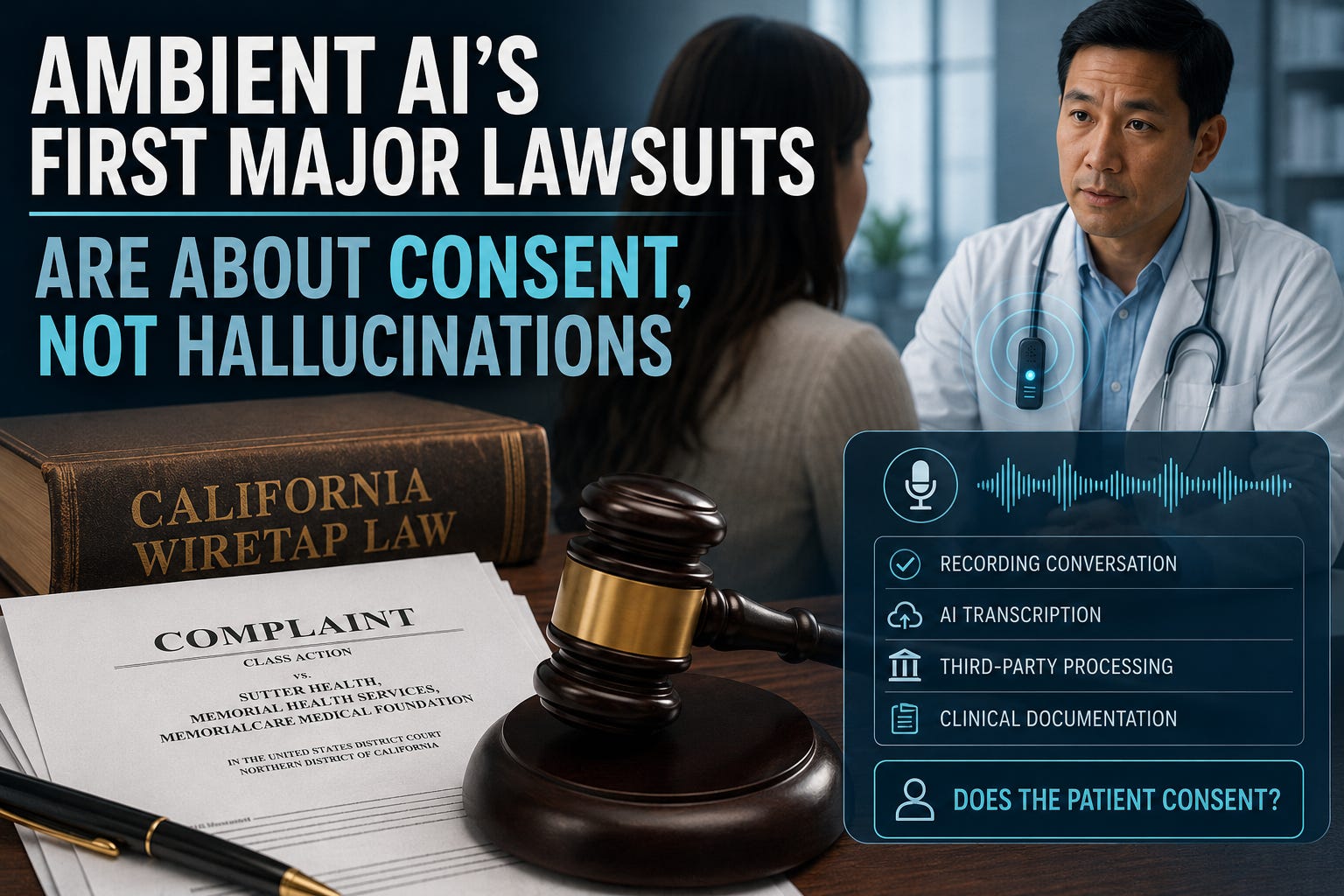
Ambient AI documentation tools are entering their first real legal test, and the early lawsuits are turning out to be far more interesting than I initially expected.
A recently filed California lawsuit against Sutter Health, Memorial Health Services, and MemorialCare Medical Foundation focuses on the use of Abridge ambient AI technology during patient encounters. The case is fundamentally about consent and recording law, not AI accuracy.
What The Lawsuit Actually Alleges
According to the complaint, patients allege their medical conversations were:
recorded
transcribed
processed by AI systems
transmitted to third-party vendors
without meaningful informed consent.
The complaint repeatedly emphasizes that patients were (allegedly) not clearly informed that:
An audio recording was occurring
Conversations would be transmitted externally
AI-generated transcripts and summaries would be created from the encounter
The lawsuit also makes another important distinction that may become central to future healthcare AI litigation:
Consent for medical treatment is not necessarily the same thing as consent for AI-enabled audio recording and third-party processing.
That may ultimately become one of the defining legal questions for ambient AI in healthcare.
The Most Interesting Detail In The Complaint
One allegation stood out to me more than anything else.
The plaintiffs claim they later discovered chart documentation indicating consent had supposedly been obtained, despite alleging that no actual consent discussion occurred during the visit.
If proven, that becomes a very different type of case. At that point, the dispute changed from whether patients fully understood the technology to whether the consent process itself was properly performed and documented.
Some reporting around the Sharp HealthCare litigation also alleges that automatically inserted consent language may have appeared in notes or charts despite patients claiming consent was never discussed.
That detail, if accurate, raises an obvious operational lesson for health systems deploying ambient AI:
Automatically generated consent attestations should be turned off entirely unless they require active clinician confirmation.
The complaint also emphasizes the highly sensitive nature of the conversations involved, including discussions around:
Diagnoses
Medications
Mental health
Protected health information
That context likely strengthens the plaintiffs’ argument that patients reasonably expected a higher standard of privacy protection inside the exam room.
Abridge Itself Appears To Recognize Consent Matters
One especially notable detail is that Abridge’s own support documentation includes suggested consent language for clinicians. They suggest:
“I will be using a tool that records our conversation to help me write my clinical note, so I can pay more attention to our conversation and less time on the computer. Is that okay with you?”
Official Abridge documentation:
Abridge also instructs clinicians to follow their organization’s consent guidelines before recording begins. That matters because it suggests the industry itself already recognizes that explicit disclosure and patient awareness are important operational safeguards.
Interestingly, several academic medical centers using Abridge publicly describe verbal consent workflows as standard practice.
Yale New Haven Health explicitly states that recording begins only after verbal patient consent is obtained.
UCSF guidance for clinicians using Abridge goes even further, recommending clinicians obtain consent from every individual potentially captured in the recording, including family members, interpreters, and staff.
Why California Changes Everything
California is one of the country’s all-party consent states. In practical terms, that means everyone involved in a conversation must consent before recording occurs. That creates a much tougher legal environment for ambient AI systems compared with many other states.
The complaint leans heavily on:
California wiretap law
The California Invasion of Privacy Act (CIPA)
The California Confidentiality of Medical Information Act (CMIA)
And this becomes especially important for healthcare leaders deploying ambient AI nationally because a workflow that feels operationally routine in one state may create meaningful legal exposure in another.
The Consent Map Matters
The legal risk changes dramatically by state.
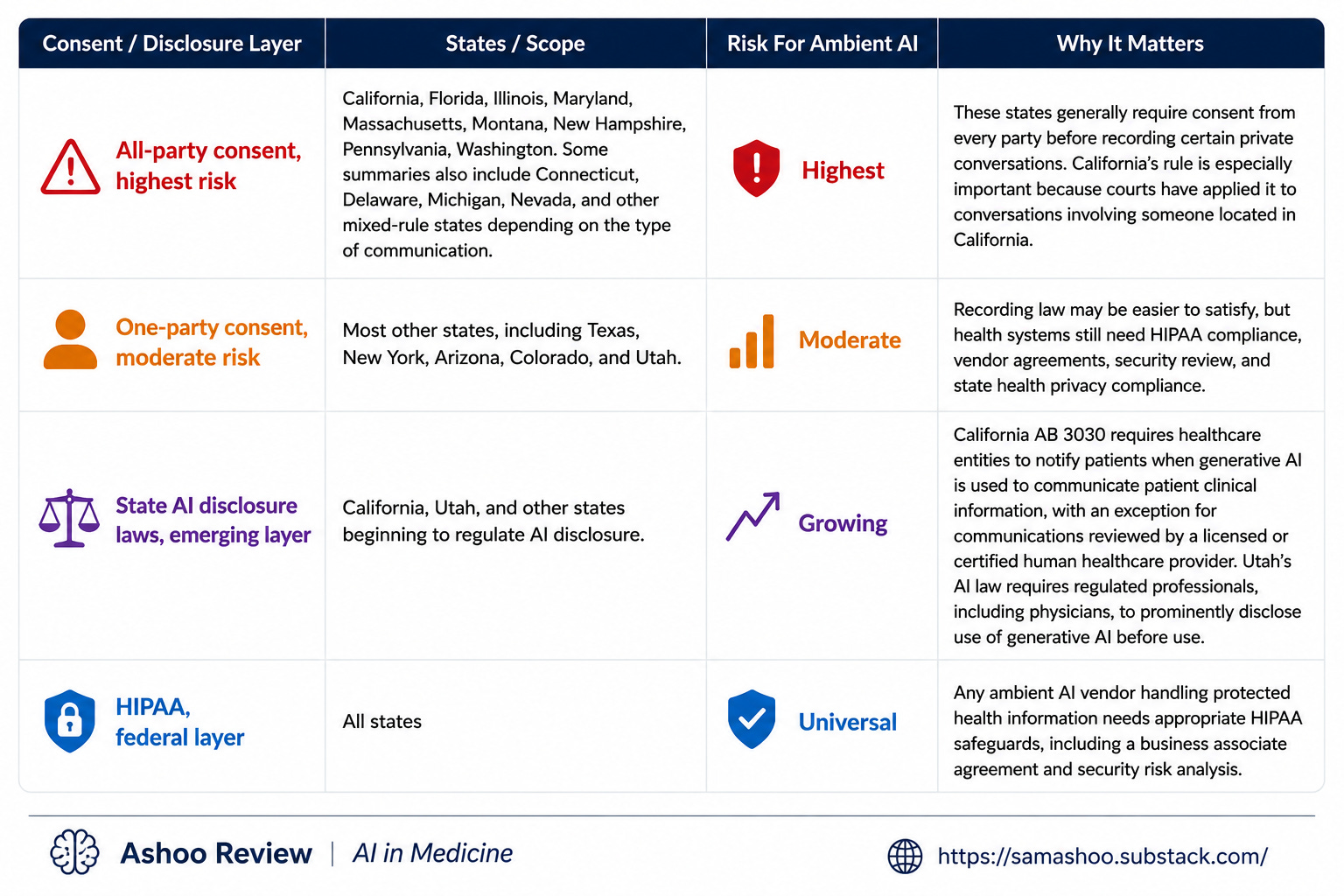
The exact list of all-party consent states varies depending on whether the source is discussing phone calls, in-person conversations, civil liability, or criminal liability.
What Health Systems Can Do Today
None of this means health systems should stop deploying ambient AI. However, it does mean governance needs to mature much faster. A few practical steps are important:
1. Use explicit verbal consent workflows
Clinicians using ambient AI should have a standardized verbal consent process before recording begins.
Patients should understand:
Recording is occurring
AI transcription will occur
A third-party vendor may process the conversation
The purpose is clinical documentation
2. Turn off automatic consent attestations
This may be one of the biggest operational lessons emerging from this lawsuit. Automatically inserted consent language in notes or charts creates an obvious risk if the conversation never actually occurred. Consent documentation should require active clinician confirmation.
3. Build state-specific workflows
An ambient AI workflow that feels routine in Texas may create very different legal exposure in California. Health systems deploying nationally should not assume recording consent rules are uniform across states, especially for telehealth and cross-state care.
4. Review vendor defaults carefully
Ambient AI platforms often include configurable settings related to:
Recording
Retention
Consent documentation
Transcript storage
Secondary data use
Those defaults matter more than many organizations probably realize.
5. Prepare for patient questions now
Patients are increasingly going to ask:
“Was I recorded?”
“Who heard this?”
“Was this used to train AI?”
“Can I decline?”
The organizations that handle this best will be the ones that treat transparency as part of the clinical workflow rather than a legal disclaimer buried inside intake paperwork.
This Is Different From The Other AI Recording Lawsuits
Several AI recording lawsuits are now getting grouped online, but they are actually about very different issues.
The Otter.ai Case
The Otter.ai lawsuit focuses on AI meeting assistants joining Zoom, Google Meet, and Microsoft Teams calls, then transcribing and analyzing conversations without sufficient participant consent.
That case centers on AI meeting bots rather than clinical encounters.
The Illinois RingCentral / Heartland Dental Case
The Illinois lawsuit involved AI-powered call analytics and transcription for business communications.
Earlier this year, a federal judge dismissed the federal wiretap claims under the “ordinary course of business” exception within the Electronic Communications Privacy Act. That ruling may ultimately help some AI communications vendors.
At the same time, the decision did not address California’s stricter all-party consent framework, which is one reason the California healthcare litigation may prove far more consequential.
The Bigger Issue Emerging
What makes these cases so fascinating is that they are forcing courts to answer a question that existing law never anticipated:
When an AI system listens continuously, generates transcripts, and creates structured summaries in real time, is that legally different from traditional recording?
For now, plaintiffs are arguing that it is not different at all. And if courts ultimately agree, the first major legal battles around ambient AI may have nothing to do with hallucinations and more to do with consent, recording law, and patient expectations of privacy.
Sources
California healthcare ambient AI complaint
Reporters Committee recording guide